Database Management
On this page, you can find how to create and delete databases within your main database instance in the Cloud Console, and how to manage extensions of PostgreSQL and TimescaleDB databases.
Table of contents
Databases tab
The DATABASES TAB of the Database details page lists the databases inside your instance (it is not shown for Redis, which has no named databases). Columns: Name; Charset and Collation (PostgreSQL, TimescaleDB, MySQL and MariaDB only); Extensions and Settings (PostgreSQL and TimescaleDB only); Notes - shown only when something was not applied, with the reason.
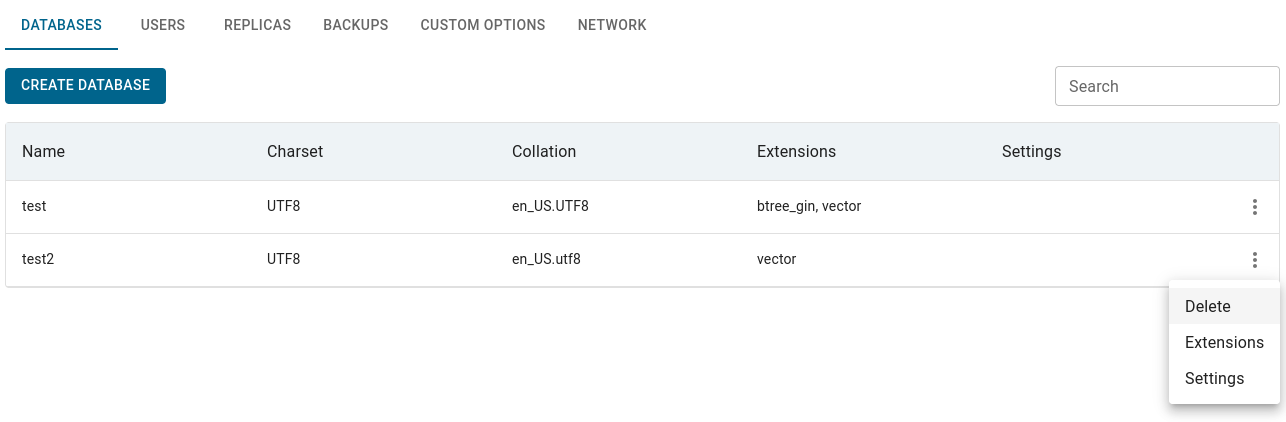
Create. Click CREATE DATABASE and fill in:
- Database Name - starts with a Latin letter or underscore; Latin letters, digits, hyphens and underscores, up to 63 characters. Names reserved by the engine (for example
postgres,template0,mysql,information_schema,admin) are refused. - Charset and Collation - not asked for MongoDB. If the engine refuses the selected pair, the database is created with the server default and the notice Charset and collation not applied (server default used) is shown.
- Extensions (PostgreSQL and TimescaleDB) and their settings, see below.
Delete. Use Delete in the row Actions menu and type the name of the database to confirm.
Deleting a database permanently removes all its contents. This action cannot be undone.
The list is read-only for a Replica (its databases follow the primary database) and for Databases whose databases and users are managed inside the engine, see User Management.
Extensions and Settings
PostgreSQL and TimescaleDB databases can use extensions. The platform installs them, you only select the ones you need; extensions that cannot run on the version of your instance are not offered.
| Extension | Description | PostgreSQL | TimescaleDB |
|---|---|---|---|
| vector | pgvector: vector types and nearest-neighbour search (HNSW, IVFFlat) for embeddings. PostgreSQL 13-18; enabling it restarts the database | yes | - |
| pgcrypto | cryptographic functions: hashing, password hashing, PGP encryption | yes | yes |
| uuid-ossp | UUID generation functions | yes | yes |
| pg_trgm | trigram similarity and fast LIKE/ILIKE search | yes | yes |
| hstore | key/value pairs in a single column | yes | yes |
| ltree | hierarchical tree-like labels | yes | yes |
| citext | case-insensitive text type | yes | yes |
| btree_gin, btree_gist | operator classes for scalar types | yes | yes |
| intarray | functions and indexes for arrays of integers | yes | yes |
| tablefunc | table functions including crosstab() | yes | yes |
| pg_stat_statements | statistics of every SQL statement; enabling it restarts the database | yes | yes |
TimescaleDB itself is created automatically in every database of a TimescaleDB instance.
Choosing extensions. Select extensions when you create the instance (they go to the initial database), when you create a database, or later with Extensions in the row Actions menu.
- Enabling an extension that needs a restart (vector, pg_stat_statements) restarts the database once; the form warns you. Until the database has restarted and the server reports the extension as installed, it is shown as (pending) in the table.
- An extension that could not be installed is shown as (not applied), the reason is in the Notes column.
- Removing an extension from the list never uninstalls it, since that would delete the data that uses it: the platform only stops managing it and resets its settings. The notification after saving says so; nothing else is shown on the page.
- Before upgrading the version, check that the extensions in use exist on the new version; the edit form warns you about the ones that do not.
Extension settings. vector, pg_trgm and pg_stat_statements have per-database settings. Open Settings in the row Actions menu, change the values and save. They are applied without a restart. Every field shows its allowed range and default; an empty value means the extension default. A setting the engine refuses is shown as (not applied) with the reason in Notes and in the notice Settings not applied.